Two minutes
The whole process, explained.
From ordinary air to a clean stack: what the plasma does to the molecule, and how the two systems sit on a real line.
Nothing loads from YouTube until you press play.
What it is
A discharge that does not heat the air.
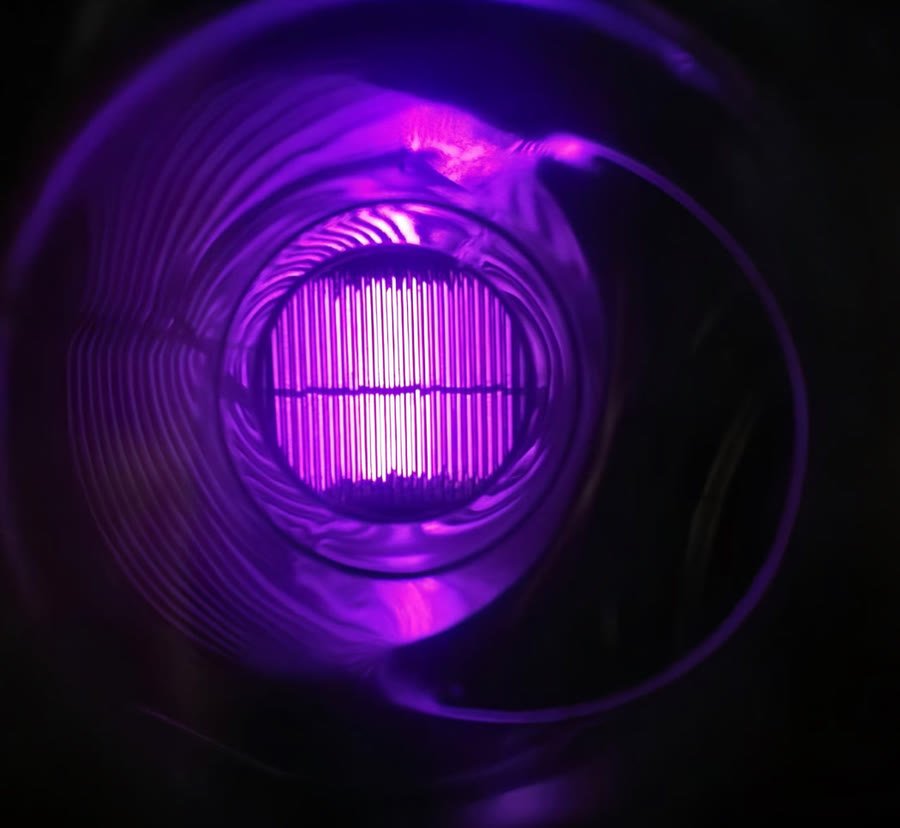
Non thermal plasma, also called cold plasma, is an electrical discharge sustained in air at atmospheric pressure and near ambient temperature. It does not heat the gas. What it does is knock ordinary air molecules into short lived, highly reactive fragments.
Those fragments are the working part of the process. They are grouped as ROS, reactive oxygen species, and RNS, reactive nitrogen species. The plasma activates the air and makes the air itself the reagent. Nothing is trapped, so nothing is left to empty, burn or bury.
The reaction
The odour molecule stops existing.
Industrial odour is carried largely by sulfur compounds. The oxygen radicals made by the plasma, •OH, •HO2 and •O, attack and break them. The reaction reads OH + O + HOO + CS-CH3, giving H2O + CO2 + SO2: water, carbon dioxide and sulfur dioxide.
In plain words, the molecule that carried the smell is converted into stable, harmless compounds. It is not adsorbed and not masked, so there is no bed to saturate and no product to buy again. The same mechanism acts on bacteria and mould carried in the flow, and on part of the VOC load.
Two configurations
The reactor outside the duct, or inside it.
Indirect plasma, for odour
The reactor stays outside.
It draws in clean external air, activates it and injects it at a single point into the existing ductwork. On the reference case 1,000 m³/h of activated air treats 50,000 m³/h of process flow, along about 2 metres of duct. The plasma never touches the dirty gas, so it stays clean.
Odour removalDirect plasma, for VOCs
The duct is the reactor.
The plasma is generated inside the duct, in the contaminated air, and the whole process flow passes through it. It is the right arrangement when the target is a solvent concentration rather than an odour threshold.
VOC removalWhat sets it apart
It is not a dosed oxidant, and it is not a masking agent.
Against a dosed oxidant, whether a liquid reagent or a gas produced separately and fed into the flow, here the reactive species are made in the air itself, on site, and they are short lived. There is no product to buy, store and top up.
Against UV lamp systems, which do well on light loads, plasma does not depend on lamps that have to be cleaned and replaced.
Against masking agents, the difference is one of kind: a masking agent covers the perceived smell, plasma converts the molecule. Sample the air at the stack and in the first case the molecule is still there.
Against carbon, biofilters and scrubbers, plasma traps nothing: no media saturates, no living bed has to be kept alive, no effluent has to be treated. The full comparison is on the technologies compared page.
What it needs, and what it does not
In practice.
It needs electricity. Consumption is low because the air is never heated.
No water and no chemicals.
No methane, and the treatment makes no CO2.
No consumable media to replace, so no secondary waste.
The reactor is cabinet sized and connects to the ductwork you already have.
The parameters are set to the flow, the odour units or the VOC concentration, and re-set when the process changes.
Questions
Straight answers.
Does cold plasma heat the process air?
No. That is the difference from thermal oxidation: non thermal plasma works at the temperature your duct already runs at, and there is no flame.
How much does it abate?
On odour, abatement is over 90%. The figure depends on the inlet load and on the reaction path available, and it is verified by analysis at the inlet and at the outlet.
How much maintenance does it need?
Little, and infrequent, in the order of one visit every 6 to 12 months. There is no media to reorder and no shutdown to change a bed.
Does it suit any flow rate?
The system is modular. Installed lines run from 1,000 to 140,000 m³/h, and the largest is at a paper mill.
Next step
Tell us the number and we will tell you if it works.
The flow rate in m³/h, the sector and what you are treating is enough for a first honest answer.
Send us your flow The technologies compared