What VOCs are
If a solvent is used, VOCs are leaving with the air.
Volatile organic compounds are released into the atmosphere by a wide variety of industries, above all those that use solvents at some stage of production.
What they do to people
VOCs are linked to respiratory illnesses and to cancer, and they are toxic to reproduction. A VOC emission is a workplace safety question as much as a stack question.
What they do outside the fence
In the environment, VOCs damage crops and vegetation, and they act as greenhouse gases.
The conventional controls
Burn it, or trap it. Both cost you every day.
The conventional VOC control systems are thermal and catalytic oxidisers, and adsorption on activated carbon filters. Each one works. Each one also comes with a bill that never stops.
An oxidiser heats the whole airflow until the molecule breaks down, burning methane to raise the air to 700°C. The amount of methane is very high and burning it produces large quantities of CO2. On a 100,000 scfm line the gas alone is roughly $275,000 a year.
Activated carbon captures the VOC on the media instead of destroying it. The bed saturates, the swap costs $10,000 to $20,000 every 6 to 12 months, and the spent carbon leaves as hazardous waste. Operators lose 100 to 200 hours a year to media handling. The solvent has not gone anywhere: it is in a drum you now pay to get rid of.
Thermal oxidiser
- Burns methane to raise the air to 700°C
- The methane consumption is very high
- Produces large quantities of CO2
- Huge investment and operating costs
- By-product emissions of its own
PURA direct plasma
- No methane, none at all
- Zero CO2 from the treatment
- By-product free, and no media to replace
- Low investment and low operating costs
- Low energy consumption
What a combustor needs most is the one thing PURA never uses: a flame.
The reactive species are made from the air already in your duct.
The direct plasma system
The plasma is generated in the flow, not beside it.
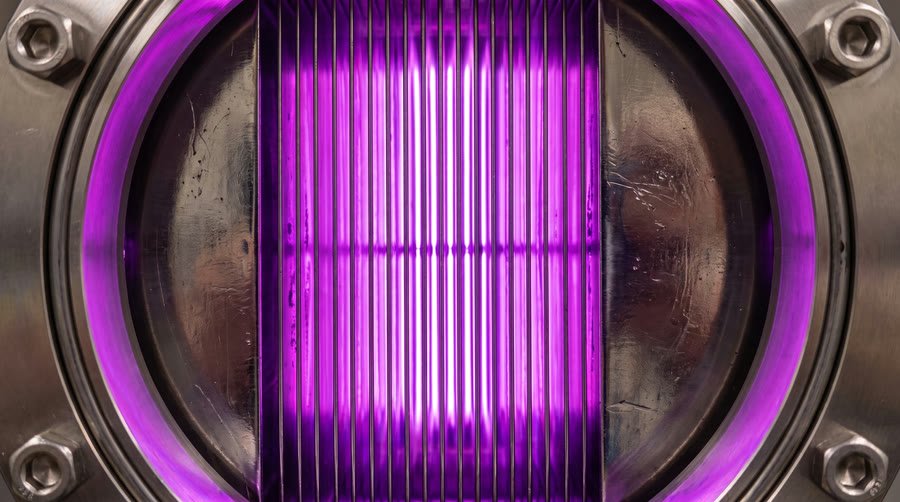
No separate reactor beside the line, no clean-air stream, no injection point. The plasma is struck inside the duct, in the contaminated air itself, so the whole process flow passes through it. On the reference case that flow is 50,000 m³/h.
All of it goes in
The contaminated process air enters the treated length of duct at full rate. Nothing is split off, nothing is bypassed. On the reference case, 50,000 m³/h of solvent-laden air goes in at one end.
The air becomes the reagent
Non thermal plasma is generated inside the duct. The air already flowing there is turned into reactive oxygen species, the radicals •OH, •HO2 and •O, with reactive nitrogen species alongside them. Every molecule in the stream meets them, because that is where they are made.
The stack answers back
The discharge is modulated to the flow, so treatment follows the load rather than a setting made on commissioning day.
Why a plant chooses direct
Because the full flow meets the discharge, and it is the discharge that has to meet your limit. That is the right arrangement when the pollutant concentration is what is being attacked rather than an odour threshold. A solvent-laden stream is loaded, so all of it goes through the plasma.
What it treats
Principally VOCs. That is what the direct system is built around. Bacteria and odours are treated as well, because the reactive species do not distinguish one oxidisable molecule from another, but the VOC is the target here.
What it does not need
No water, no chemicals, no consumable media, no sludge, no waste to dispose. No methane and no CO2 from the treatment. The airflow is never heated: non thermal plasma works at the temperature your duct already runs at.
Tuned to the load
Solvent loads are rarely steady through a shift. The plasma parameters are adjustable, so the discharge is set to what the duct actually carries and the abatement holds over time.
Direct or indirect
Two systems, and they are not interchangeable.
PURA builds both, and which one belongs on your line depends on what you are trying to get rid of.
The direct system on this page puts the plasma inside the duct and sends the whole flow through it. Ask about it when solvent is the problem and the limit you have to meet is a concentration.
If your problem is a smell rather than a solvent load, the indirect system is the other half of the answer: the reactor sits outside the duct on clean external air, and a small activated flow is injected into a large process flow. Read odour removal for that one.
Direct plasma is for VOCs. Indirect plasma is for odours.
Both use the same reactive chemistry. Neither uses water, chemicals, consumables, methane or a flame.
The plain facts
Eleven things the machine does, and does not, need.
Modular, so it suits any air flow.
Easy to install and easy to use. Plug and play.
High abatement rate.
Plasma parameters adapt to the characteristics of the flow.
Highly efficient, with low energy consumption.
Maintenance is infrequent and its cost is low.
No water and no chemicals in the process.
No waste to dispose.
No methane.
No CO2 produced.
Environmentally friendly, for all ten reasons above.
Where it runs
Machines on real sites.
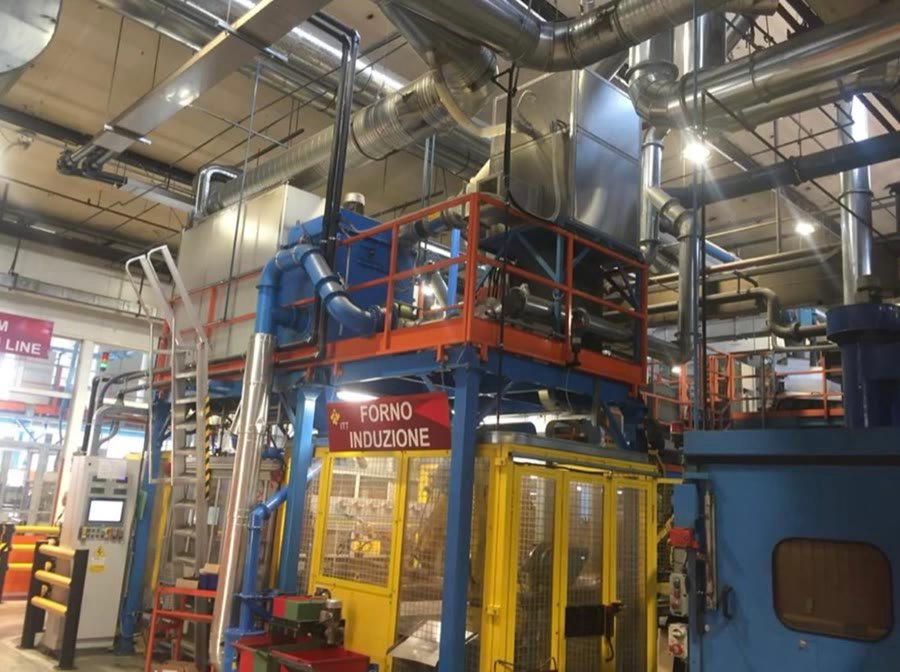
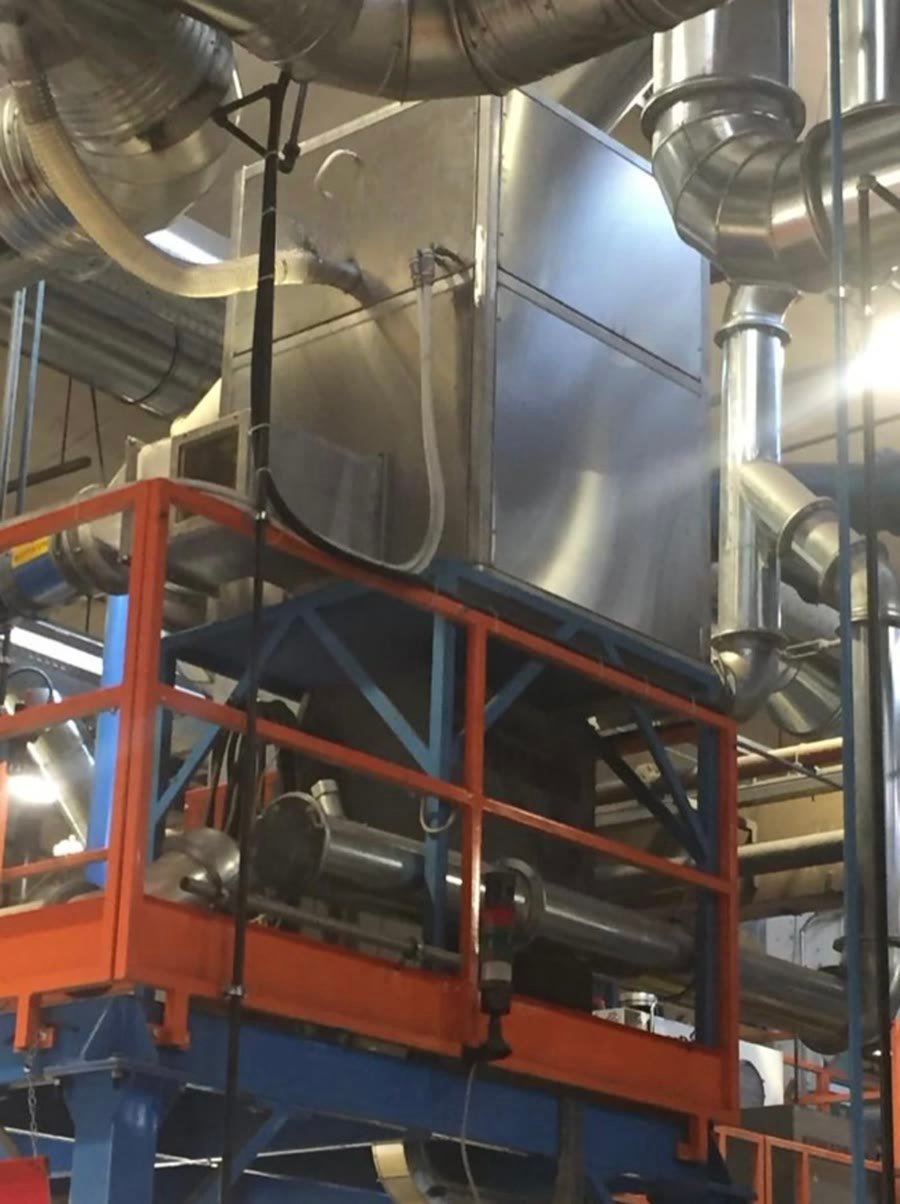
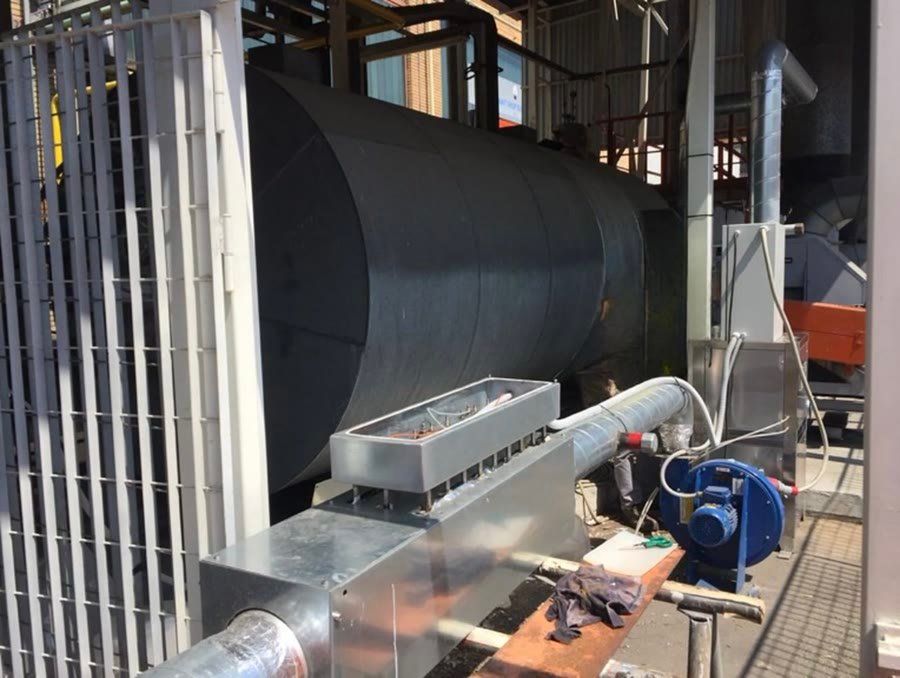
Two of PURA's listed VOC installations are in the automotive industry, on brake pad production and on an automotive painting line. The photographs below are from our own VOC installations. They are not matched one to one with the lines listed above.
The questions we get about VOCs
Straight answers.
Does the whole flow really pass through the plasma?
Yes. That is what makes it the direct system. The plasma is generated inside the duct, in the contaminated air, with no separate clean-air line and no injection point. On the reference case, 50,000 m³/h goes through the treated section.
Our concentration swings through the day. Will the abatement hold?
The plasma is adjustable rather than fixed at commissioning. The discharge is set to the load, so you are not paying full energy to treat nearly clean air.
Is a plasma discharge in solvent-laden air the right choice for us?
That depends on your solvent mix, your concentration and your duct, and PURA answers it for the specific case. The plasma is non thermal, so the air is not heated and there is no flame. Where the load is a smell rather than a solvent concentration, the indirect system is the better fit: the reactor stays outside the duct on clean external air, and it takes odour, bacteria and mould, plus a small part of the VOC load.
What will it cost to run against the oxidiser we have now?
PURA's only running input is electricity, so the comparison is your gas bill against a power bill, with no carbon swaps and no hazardous waste. An honest number needs your flow and your gas price.
Send us your flow
Tell us the number and we will tell you if it works.
The flow rate in m³/h, the sector, and what you are trying to get rid of is enough for a first honest answer.
No methane, no carbon, no CO2. The whole flow goes through the plasma.
Send us your flowPURA, Pralormo (TO), Italy. eco@pura.eco, +39 353 475 5542.